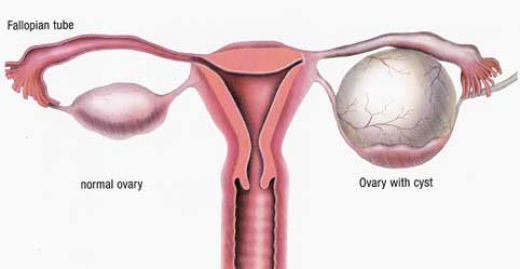
Ovarian cysts are small fluid-filled sacs that develop in a woman's ovaries. Most cysts are harmless, but some may cause problems such as rupturing, bleeding, or pain; and surgery may be required to remove the cyst(s). It is important to understand the function of the ovaries and how these cysts may form.
Women normally have two ovaries that store and release eggs. Each ovary is about the size of a walnut, and one ovary is located on each side of the uterus. One ovary produces one egg each month, and this process starts a woman's monthly menstrual cycle. The egg is enclosed in a sac called a follicle. An egg grows inside the ovary until estrogen (a hormone), signals the uterus to prepare itself for the egg. In turn, the lining of the uterus begins to thicken and prepare for implantation of a fertilized egg resulting in pregnancy. This cycle occurs each month and usually ends when the egg is not fertilized. All contents of the uterus are then expelled if the egg is not fertilized. This is called a menstrual period.
In an ultrasound image, ovarian cysts resemble bubbles. The cyst contains only fluid and is surrounded by a very thin wall. This kind of cyst is also called a functional cyst, or simple cyst. If a follicle fails to rupture and release the egg, the fluid remains and can form a cyst in the ovary. This usually affects one of the ovaries. Small cysts (smaller than one-half inch) may be present in a normal ovary while follicles are being formed.
Ovarian cysts affect women of all ages. The vast majority of ovarian cysts are considered functional (or physiologic). This means they occur normally and are not part of a disease process. Most ovarian cysts are benign, meaning they are not cancerous, and many disappear on their own in a matter of weeks without treatment. While cysts may be found in ovarian cancer, ovarian cysts typically represent a harmless (benign) condition or a normal process. Ovarian cysts occur most often during a woman's childbearing years.
The most common types of ovarian cysts are the following:
Follicular cyst: This type of simple cyst can form when ovulation does not occur or when a mature follicle involutes (collapses on itself). A follicular cyst usually forms at the time of ovulation and can grow to about 2.3 inches in diameter. The rupture of this type of cyst can create sharp severe pain on the side of the ovary on which the cyst appears. This sharp pain (sometimes called mittelschmerz) occurs in the middle of the menstrual cycle, during ovulation. About one-fourth of women with this type of cyst experience pain. Usually, these cysts produce no symptoms and disappear by themselves within a few months.
Corpus luteum cyst: This type of functional ovarian cyst occurs after an egg has been released from a follicle. After this happens, the follicle becomes what is known as a corpus luteum. If a pregnancy doesn't occur, the corpus luteum usually breaks down and disappears. It may, however, fill with fluid or blood and persist on the ovary. Usually, this cyst is found on only one side and produces no symptoms.
Hemorrhagic cyst: This type of functional cyst occurs when bleeding occurs within a cyst. Symptoms such as abdominal pain on one side of the body may be present with this type of cyst.
Dermoid cyst: This is a type of benign tumor sometimes referred to as mature cystic teratoma. It is an abnormal cyst that usually affects younger women and may grow to 6 inches in diameter. A dermoid cyst can contain other types of growths of body tissues such as fat and occasionally bone, hair, and cartilage. These cysts can become inflamed. They can also twist around (a condition known as ovarian torsion), compromising their blood supply and causing severe abdominal pain.
Endometriomas or endometrioid cysts: Part of the condition known as endometriosis, this type of cyst is formed when endometrial tissue (the lining tissue of the uterus) is present on the ovaries. It affects women during the reproductive years and may cause chronic pelvic pain associated with menstruation.
-Endometriosis is the presence of endometrial glands and tissue outside the uterus.
-Women with endometriosis may have problems with fertility.
-Endometrioid cysts, often filled with dark, reddish-brown blood, may range in size from 0.75-8 inches.
Polycystic-appearing ovary: Polycystic-appearing ovary is diagnosed based on its enlarged size - usually twice that of normal - with small cysts present around the outside of the ovary. This condition can be found in healthy women and in women with hormonal (endocrine) disorders. An ultrasound is used to view the ovary in diagnosing this condition.
Polycystic-appearing ovary is different from the polycystic ovarian syndrome (PCOS), which includes other symptoms and physiological abnormalities in addition to the presence of ovarian cysts. Polycystic ovarian syndrome involves metabolic and cardiovascular risks linked to insulin resistance. These risks include increased glucose tolerance, type 2 diabetes, and high blood pressure.
-Polycystic ovarian syndrome is associated with infertility, abnormal bleeding, increased incidences of miscarriage, and pregnancy-related complications.
-Polycystic ovarian syndrome is extremely common and is thought to occur in 4%-7% of women of reproductive age and is associated with an increased risk for endometrial cancer.
Cystadenoma: A cystadenoma is a type of benign tumor that develops from ovarian tissue. They may be filled with a mucous-type fluid material. Cystadenomas can become very large and may measure 12 inches or more in diameter
Look out for causes and treatment of cysts in the next blog post :)